The same surplus idea, expressed in wins instead of dollars — so a 1990 bargain and a 2025 bargain are directly comparable.
Raw dollar surplus is dominated by inflation — a win cost ~$0.5M in 1990 and ~$8M today, so recent players swamp the all-time dollar leaderboards. WAR Surplus fixes that by charging a player's salary in win-units: how many wins he produced above the number his salary "should" have bought at that year's price. It's the cross-era-fair version of efficiency.
Using the same season win-price \(r_t = \sum\text{salary}/\sum\max(\text{WAR},0)\), convert a player's salary into the wins it could have purchased, and subtract from his actual WAR:
\[ \text{WAR Surplus} = \text{WAR} - \frac{\text{salary}}{r_t} \]Equivalently it's just dollar surplus divided by the era's price-of-a-win — putting 1985 and 2026 on one ruler, denominated in wins.
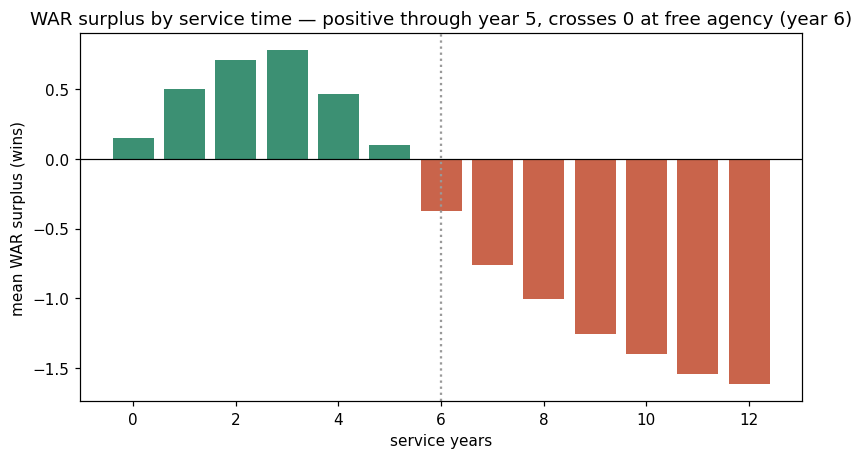
Every team-season (1985–2025) bucketed by its era-neutral WAR surplus:
| WAR surplus that season | team-seasons | made playoffs | won pennant | won WS |
|---|---|---|---|---|
| > +10 | 102 | 40% | 5% | 1% |
| +5 to +10 | 101 | 42% | 12% | 4% |
| 0 to +5 | 168 | 27% | 7% | 2% |
| −5 to 0 | 187 | 21% | 4% | 3% |
| < −5 | 630 | 25% | 7% | 4% |
Barely a slope at all — nothing like WAB's 0%→81% staircase. The most efficient rosters reach October ~40% of the time vs ~25% for the least efficient: a faint edge, no more. And as with dollar surplus, the WS column is dead flat at 1–4%. Cheap wins help you contend a little; they do not buy you titles.
Inputs: 10.1 WAR, $0.51M salary, 2013 win-price \(r_{2013}\approx\$2.6\text{M/WAR}\).
1. wins his salary "bought": \(0.51/2.6 = 0.20\) WAR
2. \(\text{WAR Surplus} = 10.1 - 0.20 = \mathbf{+9.9}\) wins
Almost his entire 10.1-WAR season was free. Crucially, this +9.9 is directly comparable to a cheap superstar season from 1990 or 2025 — the era's salary scale has been divided out, which the +$26M dollar figure can't claim.
Fit on full team-seasons (≥100 games), 1985–2024/25. All figures are franchise-level outcomes credited to the decision-maker in the relevant year — see the GM profiles for per-executive numbers.