The scouting-director analog of WAB: how much fWAR a director's picks produced above what their draft slots historically return. Plus the surprising structure of where draft skill is — and isn't — real.
Wins and rings get credited to the GM, but the amateur draft is run by the scouting director, and his raw output is dominated by where he picks — a team drafting 1st overall has far more value available than one drafting 28th. DVOS strips that out. Each pick is valued at the player's career fWAR and benchmarked against what that overall draft slot has historically returned:
\[ \text{DVOS} = \sum_{\text{picks}} \big(\text{career fWAR} - \mathbb{E}[\text{fWAR} \mid \text{draft slot}]\big) \]Value is credited only to the draft where a player actually signed (so an unsigned-then-redrafted player counts once), and recent classes are maturity-adjusted so a 2021 pick isn't punished for not having debuted. A perfectly average drafter lands at 0 by construction; +108 means his picks out-produced their slots by 108 career wins. bref WAR is never used.
520 picks across 10 drafts. Summing the slot-expectation for all 520 (mostly mid/late picks worth ~0) gives an expected ~231 fWAR; his picks actually produced ~339. DVOS = 339 − 231 = +108.
And it's almost all a few stars: McCann (64th, +49 DVOS), Freeman (78th, +47), Wainwright (29th, +34), Heyward (14th, +26) alone exceed his entire total — his other ~516 picks net slightly negative. That's the metric in one record: you're paid for the few you nail.
At the single-draft level DVOS is pure noise (year-over-year stickiness ≈ 0): one star swamps a whole class. So the real test is split-half reliability — does a director's value in half his drafts (odd years) predict the other half (even years)? Across directors with ≥6 drafts, Spearman-Brown adjusted:
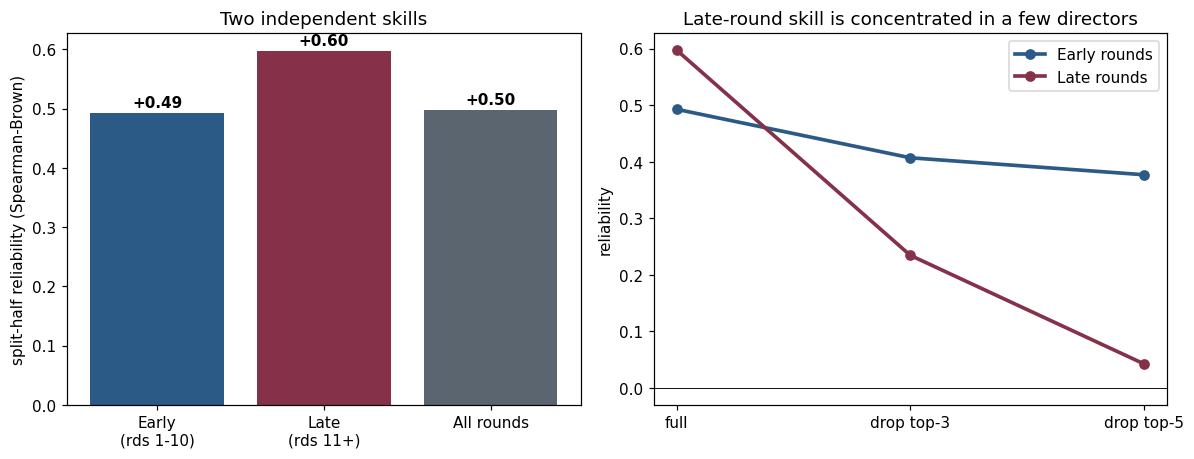
This breaks into two independent skills (an SD's early-round value is uncorrelated, ≈ 0, with his late-round value — being good at one says nothing about the other):
So scouting is real skill, but in the deep rounds it's scarce, individual, alpha-like: most directors earn the "index return" (slot value) because finding a star at pick 300 is a luck-dominated game where a repeatable edge is genuinely rare — exactly like persistent alpha among active fund managers. It is not post-2012 bonus-pool exploitation (the edge is stronger pre-2012), and it's not survivorship in a handful of orgs — it's a handful of people.
Splitting DVOS by the drafted player's position, only one cut is reliable: drafting hitters (C/IF/OF) above slot repeats (split-half +0.54), while drafting pitchers above slot does not (≈ 0). The two are nearly independent (corr +0.28), so this isn't one "drafting" skill — it's specifically a hitter-evaluation skill.
Why pitchers don't repeat — the realized fWAR of a drafted arm is mostly decided after the pick, by forces the scout doesn't control:
The upshot: pitcher value-over-slot is dominated by factors downstream of the draft decision, so it doesn't repeat for a given evaluator — the classic "there is no such thing as a pitching prospect." That's why the leaderboard ranks Hit DVOS but shows Pitcher DVOS only descriptively. (Finer buckets like SS or C are too thin per director to be anything but noise.)
Fit on full team-seasons (≥100 games), 1985–2024/25. All figures are franchise-level outcomes credited to the decision-maker in the relevant year — see the GM profiles for per-executive numbers.